


Nobody sees more boating lessons unfold in real time than the people standing on the dock when you pull in which is why we're so excited to...
The Parenthood of Ranger Tug Ownership
Post by Ronni Sanlo and Kelly Watson - Published on 09/04/26 13:00 PM
There’s a particular kind of boat math that every cruiser understands: somehow, the boat you swore was plenty big enough starts feeling a little smaller every season. For Ronni and Kelly, that journey took them from a Ranger Tug 23 to a 29 and, eventually, a 43. Along the way, they discovered that owning a Ranger Tug kinda like raising a kid: they keep getting bigger, more expensive, and somehow even harder not to brag about. Here's their story:
The Parenthood of Ranger Tug Ownership
By Ronni Sanlo and Kelly Watson
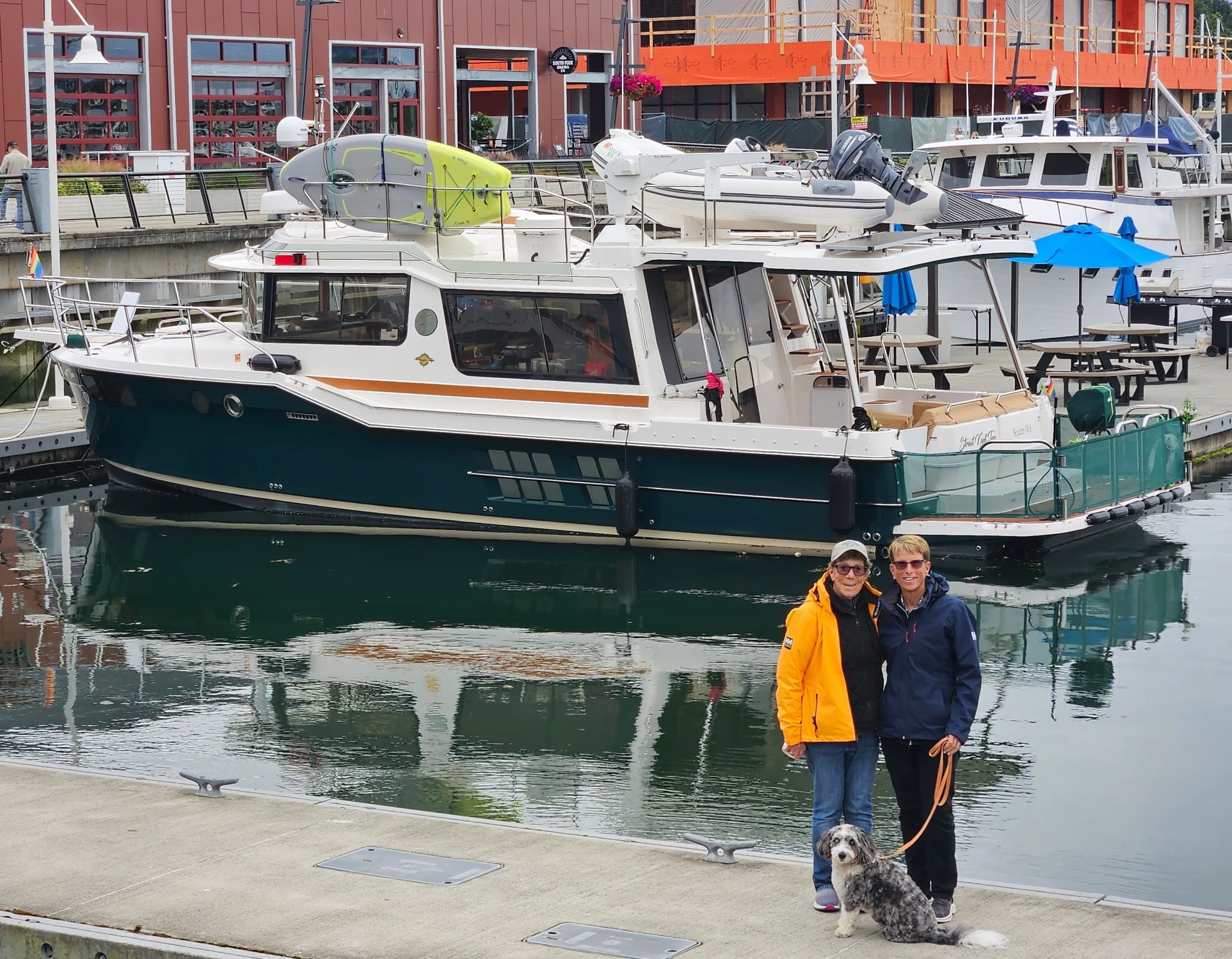
As Kelly and I cruise the Salish Sea aboard our Ranger Tug 43, Strait Knot Too, we often rendezvous with other Ranger Tug owners. It doesn't take long before the conversation turns to the same question:
"So...what Ranger did you have before this one?"
We've discovered there's a very specific progression in the Ranger Tug world. Almost nobody starts with a 43. No, first you innocently buy a small Ranger. Then you "upgrade" to a medium Ranger. Then, before you know it, you're explaining to your financial advisor why your boat has more refrigerators than your house.
We're living proof.
It all started in the summer of 2018. We were out sailing with friends from John Wayne Marina in Sequim, Washington, where we live. Afterward, we wandered down the docks admiring everyone else's boats—as one does when one has absolutely no intention of buying one.
Then we heard it. A soft humming noise. We watched as an elderly gentleman—who we later learned was over 90 years old—effortlessly docked his Ranger Tug 25. Kelly and I exchanged glances.
"Electric boat?" I whispered. We had not yet heard of bow and stern thrusters. We assumed we'd just witnessed the future of boating. Naturally, I went home and researched Ranger Tugs, discovered they were built in Seattle, and immediately made an appointment with some guy named Andrew Custis to visit the factory.
I reassured Kelly. "Nobody in their right mind buys a brand-new boat. We're just looking."
Those words should be engraved on a monument somewhere. Right next to "We'll just get one puppy."
We visited the Ranger Tug facility in Kent where Andrew greeted us warmly. "Take your time," he said. "Look around. Climb aboard any boat you like." Then he walked away.
This, we later realized, is a brilliant sales technique. Leave prospective buyers alone with their fantasies (of boats, not Andrew.)
There she sat. A brand new beautiful green-and-white Ranger Tug 23. She had a tiny stateroom, a tiny bathroom, a cute little galley, electronics that looked to us like NASA mission control, and a 200-horsepower Suzuki outboard. She was adorable. Three days later she was in our new slip at the marina in Sequim. Andrew was happy.
We named her Strait Knot because we live on the Strait of Juan de Fuca...and we're not!
A couple of Ranger guys named Tim and Kenny spent two full days teaching us how not to embarrass ourselves—or sink. We didn’t but we were still fairly clueless.
By 2020 we'd become reasonably competent boaters and were taking anchoring lessons with our Ranger friend Glenn. Somewhere during the lesson, I confessed I had two-foot-itis. Our cozy little 23 suddenly seemed...cozy.
Glenn looked at us thoughtfully. "If you're going up two feet," he suggested, "you might as well go up six."
This is the kind of financial advice only boat owners give each other.
But six feet later we owned a Ranger Tug 29. It was wider. It rode better. It had more electronics. And it had a diesel engine for which we took a diesel engine class. And Andrew was happy.
At long last, we proudly became Diesel Dykes.
The 29 served us faithfully for several years…until fourteen-foot-itis struck.
The symptoms are unmistakable:
You start browsing yacht listings "just for fun."
You convince yourself you need another refrigerator.
You begin saying things like, "Think of all the storage."
Before you know it, you're standing in front of a Ranger Tug 43.
This wasn't merely a bigger boat. This was a floating condominium. Two Volvo IPS diesel engines. A gyro stabilizer. A full-size washer and dryer. Three refrigerators. One freezer. And three—count 'em—THREE television sets. Plus enough electronics to qualify as a small data center. (A twelve-year old probably understands more of the systems than we do.)
But here's the truly magical feature: The joystick!
Forget everything you've ever heard about docking big boats. Push the joystick, the boat obeys. Sideways. Diagonally. In circles. It's practically cheating. After years of sweating every docking maneuver, I suddenly looked like I knew what I was doing. And Andrew was happy.
Now, whenever we meet other Ranger Tug 43 owners, we hear versions of exactly the same story:
"I started with a 23..."
"We had a 25 first..."
"Our first was a 29..."
It's practically a support group!
"Hello. My name is Ronni."
"Hi, Ronni."
"It's been six months since I looked at a larger boat."
Everyone applauds.
We've come to realize that Ranger Tugs are a lot like children, and really, these Ranger Tugs are our babies: the longer we have them the bigger they get (and the happier we make Andrew).
You start with a little one.
Then somehow it keeps getting bigger.
It requires increasing amounts of money.
You become irrationally proud of it.
You talk about it constantly.
You spend weekends taking care of it.
And no matter how big it gets, you still think it’s the cutest one in the marina.
Fortunately for us—and perhaps for our retirement savings—Ranger doesn't make anything larger than the 43. But if Andrew ever calls and says, "We've got a prototype...", Kelly has instructions to confiscate the checkbook.
If you run a marina and want to tell your story in The Running Fix, here's the page to start the process. And if you're a boater with a tale to tell from out there on the water, here's where to share it. Be the first to access boater stories like this one by subscribing to our boater newsletters, The Running Fix and Dock Talk!

